Apple ipad air 4th generation ipad air 4 apple apple ipad air 4th generation 64gb apples ipad air1 smart cover apple ipad air 10 9 apple ipad air tablet apple ipad pro apple s ipad pro 9 7 apple s ipad gets assistive technology boost apple s ipad 8th generation release date apple store apple stock price apple support apple saddlery apple serial number check

Apple's iPad Air 4 missed the back-to-school window, but it sure looks promising
Remote school has already begun, but iPads are still on their way. Apple's newest $599 (£579, AU$899) iPad Air looks like the best choice for older students and people who do lots of work on their tablet, but it's not arriving until October. Also, we don't know how good it is yet next to the iPad Pro... but it sure looks promising. The question is, do you get this or just pick up the less expensive new 10.2-inch iPad instead?
The new design looks iPad Pro-like, with a reduced-bezel display with curved corners like the Pro and recent iPhones. But there's no Face ID camera: Instead, there's Touch ID embedded in the top power button. This is a common thing in many other tablets, laptops and phones, but for Apple it's a new move. It seems convenient, and possibly easier than using your face.
The 10.9-inch display is a bit smaller than the 11-inch Pro, but I bet the whole thing feels like the 11-inch model in size and feel. The 11-inch Pro is my favorite size, so that's very good news: It's plenty of screen space for split-screen double apps.
The Air moves to USB-C like the iPad Pro, unlocking lots of possible accessories and dongles (but keep in mind, Apple still locks down some features in iPadOS). It also supports the Apple Pencil 2 via a side-charging magnet.

The iPad Air next to the Pro (left) and 10.2-inch iPad and Mini (right).
AppleOne surprising move is that it's the official debut of the A14 processor, as new Apple chips usually make their appearance first on new iPhones. The A14 is promised to be faster (as always), and it should be significantly better than the A12 on the last iPad Air in 2019. But it may not be as fast as the most recent iPad Pro.
The cameras look good, too: The rear 12-megapixel camera, with 4K 60fps and 240fps slow motion, looks similar to the iPhone SE camera; and the front 7-megapixel camera has Smart HDR, and can record at 1080p at 60fps.
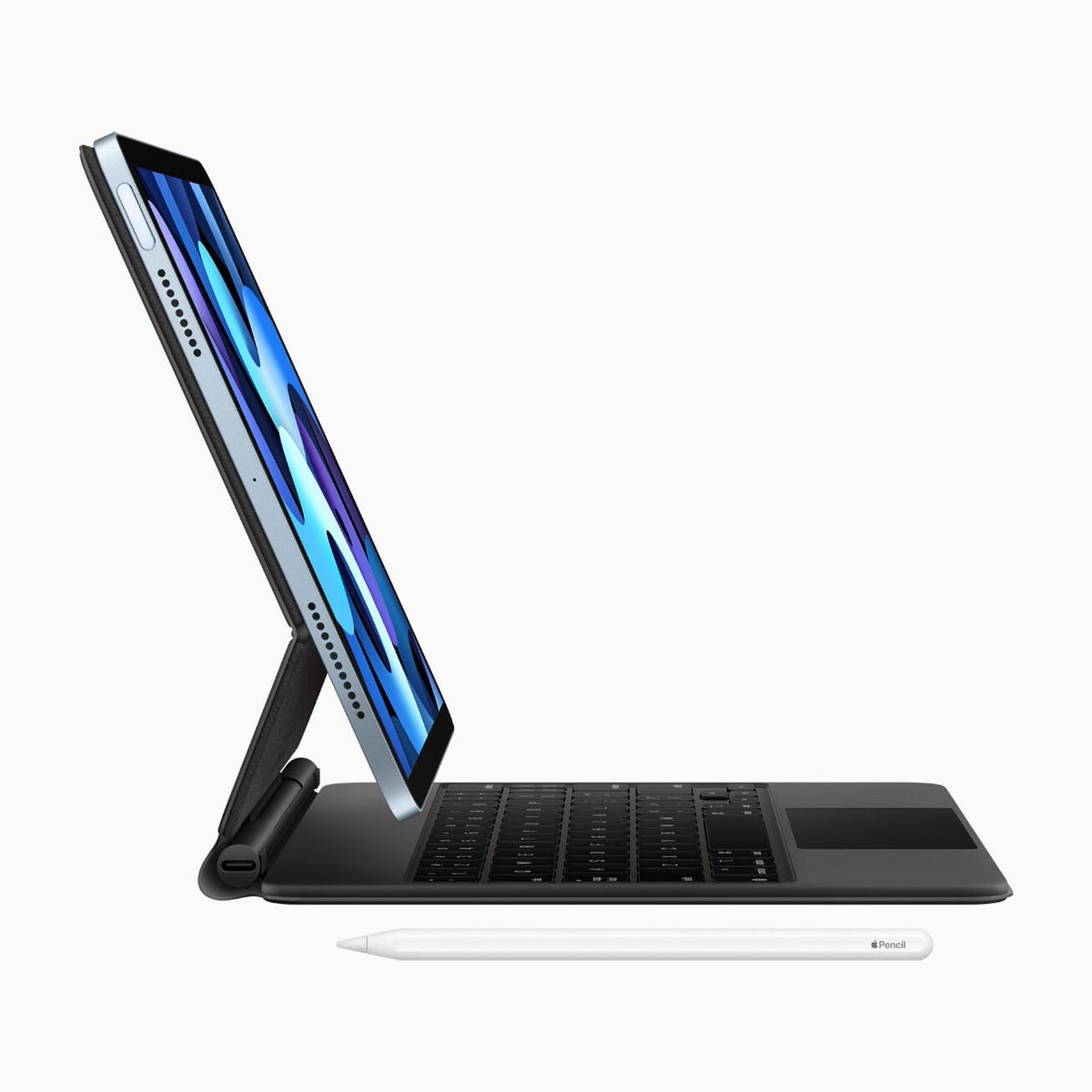
The Magic Keyboard works with the new Air.
AppleSupport for the Magic Keyboard, however, is a big plus. The Magic Keyboard is my favorite Apple iPad keyboard, but it's expensive at $299 (£299, AU$499).
It's also the first iPad that comes in a wide variety of colors: There are green and blue models, in addition to existing space gray, silver and rose gold options.
I'd mark this as the must-get iPad for anyone looking for a fancy iPad, but with accessories it'll cost you a bunch, possibly upwards of $1,000 or more. In which case, the $329 (£329, AU$499) new basic iPad with an A12 processor might still be the best bet, especially if you're on a budget or buying for kids.
§
There's a feeling I sometimes get when I slip on a pair of cozy shoes or sit down in the right chair, when a laptop keyboard feels right and I'm just feeling... comfortable. That was me, the first half hour trying out a trackpad on the new iPad Pro.
I'm at my desk. I'm typing on a keyboard, using a trackpad. Looking at a nice-sized 12.9-inch screen. And yes, this is like working on a computer.
I'm hesitant to say Apple's iPad problems have been completely solved. But damn, using a real trackpad on an iPad is a magic moment that's been three quarters of a decade overdue.
I'm wandering my home, not going anywhere, so I'll keep updating this as I test it more. It would be great if there were one singular device Apple made that could handle every one of my needs instead of several. The new iPad Pro gets closer to being there, but its price means it'll be a luxury option. And really, you're probably just fine with the iPad you have.
Read more: My hands-on with the iPad Pro's first trackpad keyboard case from Brydge
Where the trackpad shines
I love that the cursor (which is a little too big and round for me) transforms into other icons as it gets close to them. It's like touchscreens and trackpads, merging. It's intuitive. The whole experience feels a lot deeper than the accessibility-focused mouse support in iOS 13, and more suited to my needs.
I love even more that multifinger controls work exactly the way my muscle memory expected: three fingers to swipe away an app. Two fingers to swipe between app panes. Three fingers up to choose a different open app. Three fingers left and right to swap apps. I can set click to tap, and there's two-finger click, which brings up those extra menu items you get when pressing and holding on the iPad screen. It makes sense. Dare I say it's even more intuitive than the iPad's touchscreen, at least for work.
Selecting text isn't perfect yet.
Where the trackpad is still weird
I use a trackpad when I need to edit what I write. I worked on this review on the iPad. Editing with the trackpad didn't always work like a laptop trackpad would, though. Clicking and dragging, when I first tested, didn't always select text -- it sometimes dragged the cursor instead. Those hiccups made the experience annoying. They seem like they could be easily solved, but the way text selection works now makes it hard to move fast in the workflow.
Apple updated many of its core work apps, such as Pages, iMovie and Numbers, to work with trackpads better, and already it's been much better for highlighting text more normally. But third-party apps, such as Google Docs, may take a lot longer to get these optimizations.
I'd also like to pull app windows in and out more easily. Slide Over (the name for the overlay that allows a quick-glance app to float over your existing app in iPadOS) is hard to make work with the trackpad. So is adjusting the split-pane, two-apps-at-once Split View mode. The iPad already needed a more fluid multitasking OS update, which would allow me to size and move things even more flexibly. I'd love the trackpad to help more with that, too. Yes, there are always lots of open apps (and app pairings) I can zoom out to and swap between. They help, but getting to new orientations is, well, weird.
Also: Your mileage with different trackpad solutions may vary. I tested the Brydge Pro Plus keyboard case, which has a trackpad, and it functioned very differently than the Magic Trackpad. I'd avoid spending money on things like this until more options come out.
The new iPad Pro's dual rear cameras and lidar, versus the original 2018 iPad Pro's single rear camera.
The strange, wild possibilities of AR
I don't know, yet, what to make of the lidar sensor on the back of the new iPad Pro. Apple is clearly running head-first into an AR future, which should involve a headset or glasses eventually. This lidar sensor is Apple's first real hardware indicator of what could come. The scanner's 5-meter (16.4-foot) range and ability to 3D mesh an environment is exactly what should be in an AR headset, like a Magic Leap or Microsoft HoloLens. It'll likely be in Apple's next iPhones, too.
I saw hints of this future when I played with Occipital's Structure camera system for the iPad years ago. There were also Google's Tango phones, which could scan the world and do depth-mapping. Apple's solution may be far better, but I haven't been able to test it with any apps that show what it can do. In a way, it's a farther-reaching version of the close-range 3D-scanning TrueDepth camera on the front of most iPhones, and the iPad Pro.
ARKit apps load up faster and place objects better, but that's just the tip of the iceberg. Scanning 3D objects, meshing reality and overlaying things, mapping reality out via a tablet... I'm curious what comes next. For some professionals, it'll be amazing. But it's a specialized feature that most people won't need at all. And many apps are already figuring out ways to scan environments without any extra depth-sensing hardware at all.
It's a big step for Apple, and I can't wait to try what apps come next, but it's hardly necessary, and I can't judge what it can do yet.
MacBook (left) or iPad Pro (right)? The new iPad Pro is still in the middle (middle).
Otherwise, very much the same iPad Pro
The new A12Z processor on the 2020 Pro, based on Geekbench 5 benchmarks, didn't show much speed difference at all compared to the October 2018 iPad Pro. Apple hasn't made any great speed claims, either, but it promises graphics boosts and better thermals for sustained graphics over time (and for high-intensity AR stuff that the lidar sensor enables). The chip isn't based on the A13 in the iPhone 11, oddly. But then again, the iPad Pro still has blazing speed, and it's still technically the most powerful iOS device.
The design, from the excellent-but-not-OLED LCD "Liquid Retina" display to the Face ID camera to the USB-C port to the magnetically attaching Pencil, is the same. The rear camera is the lone change, with a camera-squircle similar to the iPhone 11 family that also means you'll need a new case to fit the different camera hole.
Adding more storage to the base model (128GB instead of 64GB), at least, means the $800 (or $1,000) base price is a real option to consider. Still, anyone editing video or working on graphics or art may consider the 256GB version instead.
There are other tweaks (Wi-Fi 6, which is nice for faster networking and better on-board microphones, for what it's worth), but in many ways the 2020 iPad Pro proposition is similar to what it was in late 2018.
The iPad Pro fits right in on my magic bookshelf.
But consider a less expensive iPad for a trackpad update, too
The best news is that trackpad support is coming to tons of other iPads. In these chaotic times, you could easily stay with what you have and add trackpad support for free in an update.
This is a review in progress. I want to see more updated apps that finesse the trackpad (Apple's suite of apps, including Pages and Numbers already show promise), and apps that use the new functions of AR. And I want to try a keyboard case that integrates the trackpad and see how that works, too.
This is the best iPad, but for its price it better be. It's also closer to being my One Machine. But at this moment, based on what I've experienced, I love working on it... but I'll still be using a laptop, too.
First published on March 24, 2020 at 5:30 a.m. PT.
Source


